





Intellectual Disability vs. Developmental Disability: Understanding the Key Differences
- Autism Care
- Therapy

Intellectual Disability vs. Developmental Disability: Understanding the Key Differences
The terms intellectual and developmental disability are often confused, but not interchangeable. Intellectual disabilities refer to limitations in a person’s life and cognitive skills (abilities brains use to think, read, learn, remember, and speak). A developmental disability is a broader term for any condition that starts in childhood and delays or limits physical and/or intellectual development.
Someone with a physical developmental disability will need different support than someone with an intellectual disability. Getting the right diagnosis starts with understanding this distinction. Using the right term helps each person receive the best support system.
In this article, Boundless will explain intellectual and developmental disabilities and clear common misconceptions so families can navigate these issues with empathy and confidence.
Key Takeaways:
- An intellectual disability affects how a person thinks and learns. A developmental disability is a broader term that includes many conditions that start in childhood.
- Some developmental disabilities affect the body or senses, like hearing loss or cerebral palsy, without affecting intelligence.
- Support depends on the person and the condition, not just the label. One person may need help with learning, while another may need physical or communication support.
- Brain injuries or illnesses in adulthood can cause intellectual disabilities, even if childhood development was typical.
- People with intellectual and developmental disabilities have strengths, goals, and potential. With understanding and support, they can live full and meaningful lives.
What is an Intellectual Disability?
An intellectual disability is a term that describes limitations in a person’s behavior and “intellectual” functions that start during development. This usually means a person has a below-average cognitive ability and struggles with everyday tasks like communication, self-care, or social skills.
While most definitions state that an intellectual disability must be present in childhood, that’s not always the case. Disability is one of the only minority groups that can be diagnosed at any age. An “acquired intellectual disability” can be discovered later in life. For example, a fifty-year-old man can develop an intellectual disability after a traumatic brain injury (TBI) or brain damage.
About 85% of people with intellectual disability are classified as mild; they can learn many skills but will need some extra time or support.
Some characteristics of intellectual disabilities include:
- Difficulty learning new concepts, troubles with reasoning, problem-solving, and academic skills.
- An IQ score approximately two standard deviations below average (around 70 or lower).
- Needing guidance and support to achieve daily tasks and navigate social life.
- Struggles with day-to-day skills like managing money, telling time, following social rules, or personal care (cooking, dressing, showering).
This disability itself is not a disease but a description of a certain level of functioning. Many conditions can cause intellectual disabilities, such as:
- Down syndrome or fragile X syndrome
- Complications during pregnancy and childbirth
- Cerebral palsy
- Fetal alcohol syndrome
- And others
What is a Developmental Disability?
A developmental disability is a term used to describe a group of conditions that begin at birth and continue through adolescence (the developmental period). It can cause physical, cognitive, or behavioral impairments or a combination of them. They start during childhood, typically before age 22.
Developmental disabilities affect how a child develops, meaning they can alter the way a child grows, learns, and behaves. These conditions are lifelong (or chronic). Not every developmental disability involves an intellectual one; some can only affect the body or sensory, but not intelligence.
There are many examples of these conditions, since it’s such a broad term, but some common examples include:
- Autism Spectrum Disorder (ASD)
- Cerebral Palsy
- Epilepsy
- Hearing loss or vision impairment
- Attention-Deficit/Hyperactivity Disorder (ADHD)
This is not a full list. Developmental disabilities cover conditions like learning disabilities (such as dyslexia), speech and language disorders, intellectual disability itself, and many others
Many of these disabilities are visible in early childhood, while others might only be identified when a child hits school age, and certain milestones are missed.
What is the difference between intellectual disability and developmental disability?
The key difference between an intellectual and developmental disability boils down to:
- An intellectual disability is a specific type of developmental disability centered around impairments in the way the brain functions.
- A developmental disability is a category that includes any impairment (physical, intellectual, or otherwise) that arises in childhood.
All intellectual disabilities are developmental disabilities, but not all developmental disabilities are intellectual disabilities.
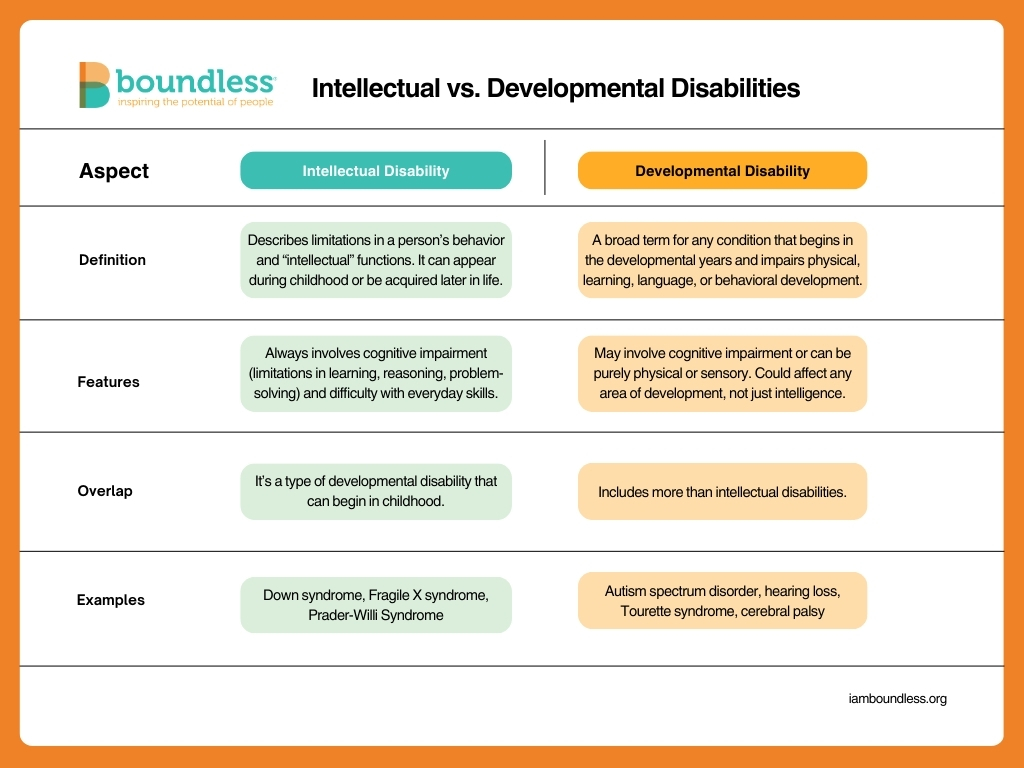
An intellectual disability (ID) zeroes in on cognitive ability. It requires meeting specific criteria, like an IQ of around 70 or below, and difficulty adapting to the world around them.
A developmental disability can be cognitive, but it can also be purely physical. For example, vision impairment affects the way a child communicates and how they adapt to the world, but it’s not an intellectual disability.
What Causes an Intellectual Disability and a Developmental Disability?
There is no straight answer to this question. Each condition has its own causes, but some contributing factors are:
Causes of Intellectual Disabilities:
- Genetic or chromosomal (extra chromosomes, gene mutations)
- Prenatal factors (exposure to alcohol, infections during pregnancy)
- Birth factors (lack of oxygen during childbirth)
- Acquired factors (head injuries, brain infections)
Causes of Developmental Disabilities:
- Mix of genetic and environmental factors (parental age or exposure to harmful substances during or after pregnancy)
- Brain injuries during or after birth (lack of oxygen during childbirth or brain bleeds)
- Infections during pregnancy or early childhood (Rubella, cytomegalovirus)
Sometimes, the exact cause of a person’s disability might be unknown.
Common Misconceptions
There are many misconceptions surrounding intellectual vs. developmental disabilities. Let’s talk about the most common ones we hear:
- “All developmental disabilities include cognitive impairment”: False. Many developmental disabilities do not affect a person’s intelligence.
- “Intellectual disability and learning disability are the same”: False. An intellectual disability affects overall IQ and everyday functioning. A learning disability is specific to one learning area despite average or above-average intelligence.
- “Autism automatically includes an intellectual disability”: False. Autism and intellectual disabilities can happen simultaneously, but that’s not always the case. Many individuals with autism have above-average intelligence.
- “ADHD is an intellectual disability”: False. ADHD (Attention-Deficit/Hyperactivity Disorder) is not an intellectual disability or a learning disability. People with ADHD generally have normal intelligence but struggle with impulse control and sustaining attention.
Examples of Developmental Disabilities that are not Intellectual
To clarify the difference, here are examples of developmental disabilities that do not inherently involve intellectual impairment:
Autism Spectrum Disorder (without intellectual impairment)
Many people on the autism spectrum have a normal or high IQ. They might need support in the way they communicate or live, but if their learning abilities are age-appropriate, they do not have an intellectual disability.
Cerebral Palsy
This disability affects muscle control and movement due to an early brain injury. The severity varies, but a lot of individuals with cerebral palsy have normal intellectual abilities. Their challenges are mainly physical or speech-related.
Epilepsy
When seizures start in childhood, epilepsy can be considered a developmental disability. Unless the seizures are very frequent or there is an underlying brain disorder, epilepsy by itself does not automatically cause intellectual impairment.
Hearing Loss or Vision Impairment
A child who is deaf or blind from a young age will have developmental issues. A hearing-impaired child won’t learn speech at an early age, but these conditions don’t necessarily affect intellect. Hearing and visually impaired people can achieve academically just like any other child.
Examples of intellectual disabilities that are not developmental disabilities
Now, let’s consider the reverse: are there cases of intellectual disability that are not developmental disabilities?
If an intellectual disability is diagnosed in childhood, it qualifies as developmental, but there are scenarios where a person can develop one outside of childhood. They’re acquired later in life and not in the “developmental” timeline. Some of them are:
- Traumatic Brain Injury (TBI) in adulthood: A person who suffers a brain injury at age 30 as a consequence of a car crash could lose the ability to solve problems, remember information, or live independently.
- Brain infections or illnesses after childhood: An adult who contracts encephalitis (brain swelling) or suffers a stroke could be left with permanent cognitive impairments.
- Genetic or metabolic conditions in adulthood: A person might have a genetic condition that causes cognitive decline starting in their twenties (like early-onset Alzheimer's). They may become intellectually disabled, but had a normal childhood development.
Conclusion and Resources for Further Learning
The terms intellectual disability and developmental disability are related but not identical. An intellectual disability affects the person’s cognitive ability and may or may not begin in childhood. A developmental disability begins in childhood and can affect cognitive ability, but it can also affect the body and behavior.
People with intellectual and developmental disabilities are first and foremost people. They have a variety of strengths, personalities, talents, and dreams. Whether a person has an intellectual disability, another developmental disability, or both, they deserve respect, opportunities, and encouragement to reach their full potential.
As the name of our organization, “Boundless,” implies, we believe in the boundless potential of every individual, regardless of label.
If you’d like to learn more or need guidance, here are some reputable resources for further learning and support:
- Eunice Kennedy Shriver National Institute of Child Health & Human Development (NICHD) – Overview of Intellectual and Developmental Disabilities (IDD).
- Centers for Disease Control and Prevention (CDC) – Developmental Disabilities. The CDC offers fact sheets and statistics on developmental disabilities.
- American Association on Intellectual and Developmental Disabilities (AAIDD) – The AAIDD is the professional organization that provides the standard definitions and criteria for intellectual disability.
- Boundless – We are a nonprofit organization with more than forty years of expertise providing person-centered care to people with intellectual and developmental disabilities.